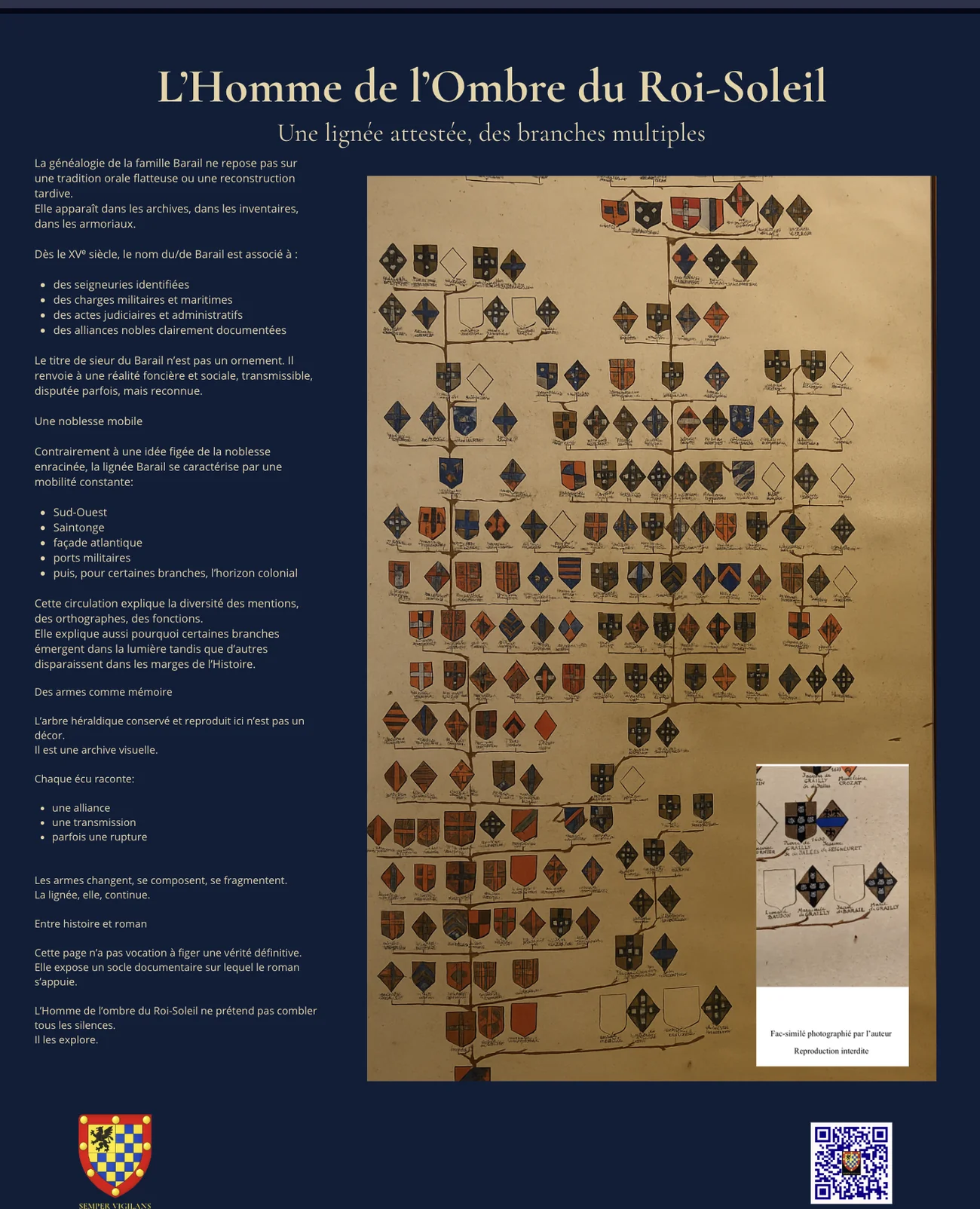
The genealogy of the Barail family does not rest on a flattering oral tradition or a late reconstruction. It appears in the archives, in the inventories, in the armorials.
From the fifteenth century onward, the name du/de Barail is tied to identified seigneuries, to military and maritime commissions, to judicial and administrative acts, and to clearly documented noble alliances.
The title of sieur du Barail is no ornament. It points to a real, transmissible social and landed standing — disputed at times, but recognised.
A mobile nobility
Contrary to a fixed idea of rooted nobility, the Barail line is marked by constant movement: the South-West, Saintonge, the Atlantic seaboard, military ports, and, for certain branches, eventually the colonial world beyond.
This circulation explains the diversity of spellings, mentions, and offices recorded. It also explains why certain branches step into the light while others fade into History’s margins.
Arms as memory
The heraldic tree preserved and reproduced here is no mere decoration. It is a visual archive. Every shield tells of an alliance, a transmission, at times a rupture.
Arms change, combine, fragment. The lineage itself endures.
Between history and novel
This page makes no claim to fix a final truth. It lays out the documentary ground on which the novel is built.
In the Sun King’s Shadow does not claim to fill every silence. It explores them.