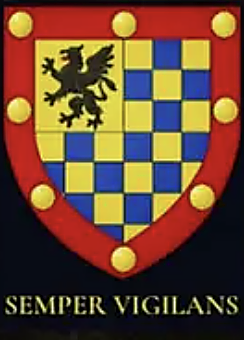
Louis Le Prévost du Barail, the hero of this novel drawn from real and familial events, moves through the Grand Siècle in keeping with the symbolism of his coat of arms. The griffin signifies a sovereign strength placed in the service of spiritual vigilance, but also the union of opposites: heaven and earth, spirit and body, good and evil locked in a process of transcendence. It becomes the symbol of a power both formidable and oriented toward the pursuit of truth and self-mastery.
The checky field reads as a symbol of order, calculation, and skill in the conduct of affairs, whether military or political. Its evenly measured squares evoke a careful distribution of forces, discipline, and a certain idea of justice.
Medieval Christian origins
In seventeenth-century France, the griffin retains a twofold religious origin inherited from the Middle Ages: at times an image of the demon and the powers of evil, at times a Christic symbol of Christ’s dual nature, human and divine. Medieval bestiaries and the patristic tradition made the griffin a symbol of Christ, uniting earth (the lion) and heaven (the eagle) — the Saviour’s two natures. Other writers, by contrast, saw in it a creature gone astray, embodying brute force or the demon itself, on account of a hybrid nature judged unnatural.